
Updated November 2026
Post-deployment monitoring is the continuous tracking of an AI system's behavior after it has been deployed into production.
AI systems are not static: they encounter new data distributions, edge cases, and usage patterns that pre-deployment testing could not anticipate. Without systematic monitoring, organizations discover drift, emerging bias, or degrading accuracy only when the consequences are already visible.
Why AI systems change after launch
This change is also known as model drift or output drift: “the degradation of output quality or accuracy as data distributions, user behavior, or operating conditions change after deployment”. Simply put, real-world inputs become different from what the model was trained on; or facts or relationships the model learned stop being true.
The model hasn’t changed, but the world around it has, so outputs that were once right stop holding.
And it isn’t only reality that shifts: the people using the system also change the system gets used for new purposes, and biases that weren’t there at launch can emerge.
We saw this in our evaluation of a public employment agency’s recruitment platform in Spain. Over five years, the gender gap in shortlisting narrowed, but fewer people overall were being shortlisted, so a smaller gap did not necessarily mean a fairer system. An audit run in 2017 and one run in 2022 would have told two different stories about the same system, without either being wrong at the time.
Other times, the systems themselves may be changed on purpose as well. A provider might update the underlying model, a prompt might be edited, the technical team may update the system to use the latest model, or the model might be retrained on new data. Behavior can then shift without anyone noticing.
Post-deployment monitoring is a way of turning accountability from a simple claim into evidence. Organizations can show their system still works as it should and that it evolves when necessary, creating trust with users, regulators and the people affected.
Monitoring in practice: an example from our work
When we assessed a US county’s tool for prioritizing support for residents at risk of homelessness, the model was accurate overall, and we found no significant disadvantage for most protected groups. What we also found was that there was no formal, ongoing review of how it performed.
That gap mattered because the people the tool serves change over time. As the demographics of homelessness shift, accuracy and bias problems could emerge without anyone noticing, and some inconsistencies affecting women and single veterans were already worth watching closely.
The county adopted our recommendations: closely monitoring the model’s performance for those groups, retraining it at least once a year, and putting ongoing quality assurance and monitoring in place.
How post-deployment AI monitoring works
At Eticas.ai, post-deployment monitoring can be the next step after an evaluation. During the initial evaluation, we identify the metrics that matter, set benchmarks, and define thresholds.
During the evaluation, we look at the full system, including the data, model, business rules, software, people and processes, and the risks that matter differ by type of system – expert & predictive systems (classifiers, scoring models, decision-support tools), LLM-based systems (generative AI, RAG pipelines, AI-assisted workflows) and agentic systems (autonomous agents and multi-step pipelines using tools, memory and external services).
Monitoring then tracks the metrics automatically at agreed intervals, and alerts the organization when material changes occur, before they become problems. Frequency is agreed with each client based on the system's risk profile, the pace of change in the deployment environment, and applicable regulatory requirements. Depending on the system, that can mean anything from every day to every month.
It is important to note that monitoring does not replace re-evaluation. An evaluation is valid for one year by default, and a new one is needed sooner after a material model or prompt change, a design change, a scope expansion such as new jurisdictions or populations, or a relevant regulatory change. Each re-evaluation updates the risk picture and resets the monitoring benchmarks.
Re-evaluations are recommended on an annual basis, assuming no material system changes have happened before.
Initial evaluation vs. post-deployment monitoring vs. Re-evaluation
All of them are needed, and they answer different questions.
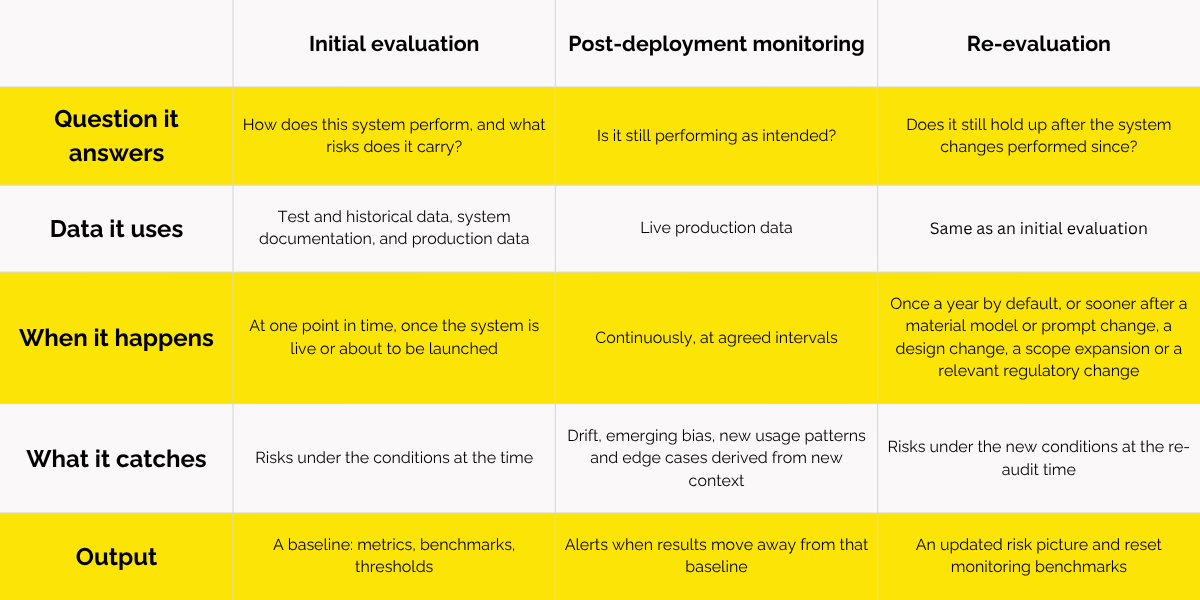
Table comparing questions for initial evaluation vs. post-deployment monitoring vs re-evaluation of AI systems
Monitoring is not available as a standalone Eticas.ai service. It depends on the evaluation to establish what to measure and what the thresholds should be. The sequencing matters: evaluation first, monitoring as its continuation, re-evaluation every year.
Since 2012, we have completed more than 200 evaluations across 15+ industries, covering predictive, LLM-based and agentic systems.
Talk to our team about how your AI performs today, and how it will perform tomorrow.