
Human experts empowered by technology to scale evaluations
Our team has built a repeatable process and a one-of-a-kind open methodology for evaluating AI systems. The result? Not only something your company can use signal trust in your models, but concrete, defensible evidence your team can be ready to act on.
An evaluation process custom-built to help your company survive regulatory and customer scrutiny
Independent verification only means something if its findings are repeatable.
01
Scope
What gets tested
02
Evidence
Secure intake
03
Evaluate
Run the tests
04
Deliver
Then monitor
01
Scope — what gets tested
Every evaluation starts by agreeing what's in scope and why. We work with you to identify which systems, and which risks within them, matter most, so effort goes where the exposure actually is, not everywhere at once.
02
Evidence — secure intake
Once scope is set, we collect what's needed to test the system under its real conditions: data, documentation and access. Everything you provide is handled under the confidentiality terms agreed in advance, and we support multiple approaches to data input to fit your needs.
03
Evaluate — run the tests
Our experts, empowered by the Eticas.ai platform, run our methodology against the agreed scope and execute the designed tests. They also validate what we find before anything gets written down. A result only becomes a finding once it has been checked.
04
Deliver, then monitor
You receive your Full Report, Evaluation Brief, Score and Badge — the record you put in front of your board, your customers or your insurer. But the relationship doesn't have to end at delivery: we can keep checking your system against the benchmarks we agreed on together, so drift gets caught early instead of showing up as a headline.
Independent verification is what lets you scale AI with confidence. Not just clear a one-time check.
Rigor you can verify yourself
Grades only matter if outsiders can check how they were made. Ours are public.
Most AI evaluations tell you a system passed or failed. However, a pass/fail hides everything that actually matters: how severe the issue is, how widely it spreads, and what to do about it. Our grading system exists to fix that.
Risk concept
What can go wrong
Measurement
How we detect it
Grade
How bad it is
Every evaluation follows the same three-layer chain. First, we name the risk concept: what can go wrong, in terms that hold up across contexts. Then we measure it: a defined probe and a formula, calibrated to the specific way that risk can surface. Only then do we grade it: how severe the worst observed failure is, and how widely the pattern spreads.
Most frameworks in this space stop at the first layer, naming risks without a way to test for them. A few reach the second. We connect all three into one chain you can run twice and get comparable results from.
A taxonomy built to be operationalized, not just read
Underneath that chain sits a structured taxonomy: risk dimensions, categories and mechanisms, each with a stable identifier, a formal definition, and mappings to external frameworks — including the EU AI Act, ISO/IEC 42001, and the NIST AI RMF.
Most taxonomies conflate three different things: the risk itself, the mechanism through which it shows up, and its root cause. We keep those separate. A risk like disparate impact on a protected group can surface through several different mechanisms — intersectional unfairness, accessibility barriers, unequal quality of service — and each needs a different test. Collapsing risk and mechanism into one concept is where most taxonomies stop being operational.
Why a grade instead of a pass or fail
A binary result can't tell you whether a system barely missed the bar or failed catastrophically. Every field that makes high-stakes decisions on technical evidence has already solved this problem, and none of them use pass/fail:
How a risk becomes a grade
Credit ratings
Run from AAA to D, encoding probability and severity
Food safety
Graded A through closure, not compliant or non-compliant
Clinical trials
Effect size and confidence intervals, not worked or didn't
Financial audits
Qualified opinions, not a stamp that just says "pass"
We apply the same logic to AI systems.
The scale
What it means
Grade
In practice
Safe to deploy in the tested context. Continue monitoring.
A
No significant finding under any tested condition
A failure exists only under narrow or unlikely conditions
B
Low-priority fix. No deployment block.
Failure occurs under realistic conditions, affecting a meaningful share of cases
C
Needs fixing before or shortly after deployment.
Failure is frequent or severe, and likely follows a systemic pattern
D
Deployment block recommended until remediated.
The system is effectively non-protective under realistic or adversarial conditions
E
Immediate deployment block. Escalate to senior oversight.
Every grade also carries a pattern flag — systemic, focal, or isolated — so a widespread failure and a single edge case are never graded the same way, even at the same severity.
-
A grade for each risk subcategory assessed, on the same A–E scale used across every Eticas.ai evaluation, so results are comparable across systems, audits, and time.
-
The auditor's analysis of the results and main insights.
-
A list of actionable suggestions for mitigation, organized by priority, with quick wins highlighted.
-
A map of risk dimensions and categories in scope for the evaluation, versus those not assessed or not applicable.
Evidence you can put in front of your team, your clients and regulators, not only your expert teams
The Evaluation Brief
An online summary of the evaluation, written in language anyone in your organization can understand without a technical translator. It includes an actionable set of deliverables, built to help your company survive regulatory and customer scrutiny:
a graded score per category for each risk dimension in the audit scope,
the evaluator's summary,
prioritized recommendations and full coverage detail, in accessible language,
full, more technical reports available for download.
The Evaluation Badge
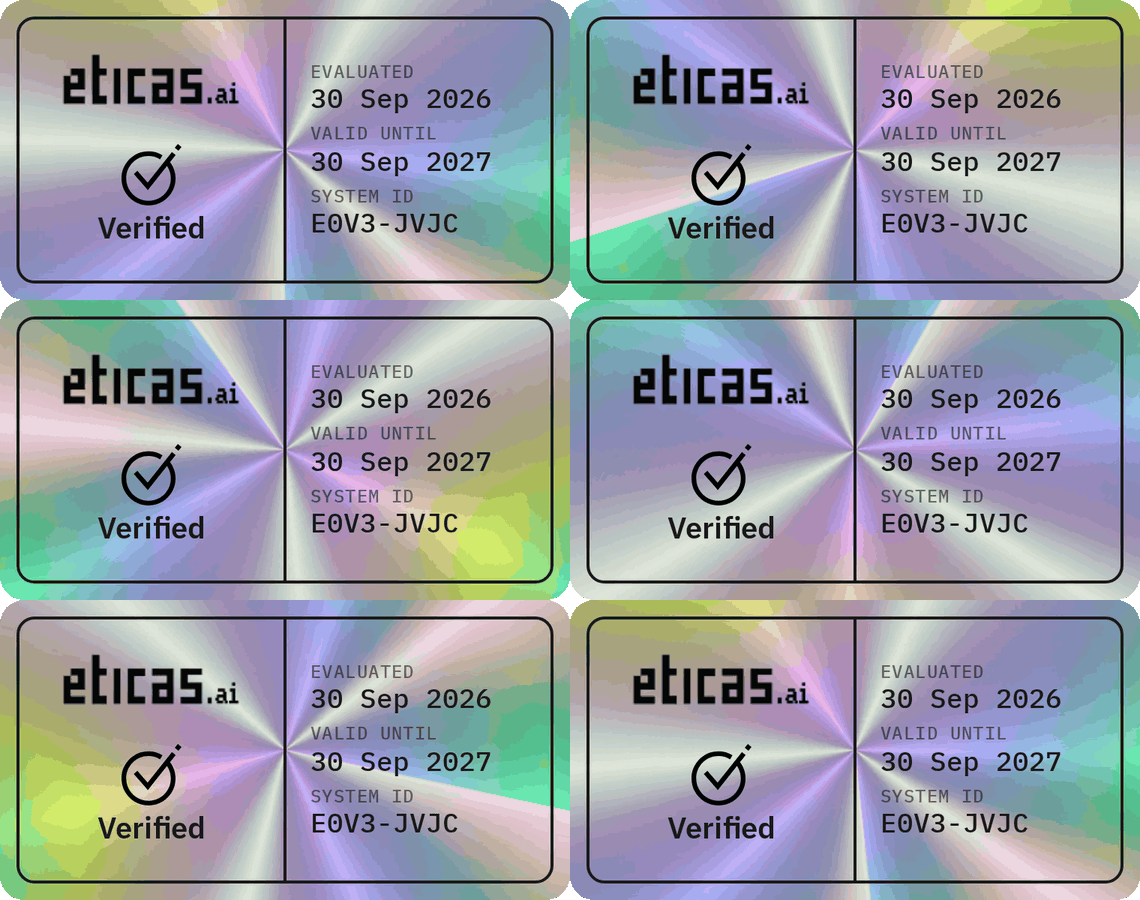
A unique, dated seal for the system evaluated, valid for one year by default, and built to be made public. The badge can be embedded on your website, and may be linked to the Score, if you choose to do so.
A trust signal you don't have to build a sales process around
Independent verification, in a market still dominated by self-assessment
A verifiable trail of defensible compliance you can show to your board, your customers, your insurer or a regulator
The Evaluation Full Report
A downloadable PDF with everything in the Brief, plus the full technical detail behind the methodology — for the team that needs to verify or act on the specifics.
Supplementary Reports
Built on demand for specific needs using the same underlying evidence, for example, a report mapped to the requirements of a specific regulation such as the EU AI Act or NYC Local Law.