Eticas.ai has been evaluating AI systems in production since 2012. This is where we share what we’ve learned. You’ll find case studies from client work, practical guides on AI governance and evaluation, reports on emerging risks, interviews with practitioners, and a glossary of the concepts that matter most in the field. Whether you build AI, deploy it, or are accountable for its outcomes, this is the evidence base we work from.

Algorithmic Accountability
Algorithmic accountability refers to the obligation of organizations that develop or deploy AI systems to take responsibility for the outcomes those systems produce — and to be able to demonstrate that responsibility to regulators, affected individuals, and the public.

Fairness Testing
Algorithmic accountability refers to the obligation of organizations that develop or deploy AI systems to take responsibility for the outcomes those systems produce — and to be able to demonstrate that responsibility to regulators, affected individuals, and the public.

Model Drift
Fairness testing evaluates whether an AI system produces systematically different outcomes for different groups of people in ways that are unjustified, harmful, or legally impermissible.

AI Explainability
AI explainability is the degree to which an AI system's outputs can be understood by the people responsible for them and by those affected by them. In practice, this means being able to account for why a system produced a given output, which inputs influenced the result, and how confident the system was in its decision.

Post-Deployment Monitoring
Post-deployment monitoring is the continuous tracking of an AI system's behavior after it has been deployed into production. AI systems are not static: they encounter new data distributions, edge cases, and usage patterns that pre-deployment testing could not anticipate. Without systematic monitoring, organizations discover drift, emerging bias, or degrading accuracy only when the consequences are already visible.

AI Risk Assessment
AI risk assessment is the process of identifying, measuring, and prioritizing the risks associated with an AI system before and during its deployment in production.

EU AI Act
The EU AI Act is the European Union’s framework for regulating artificial intelligence systems, with obligations that vary based on the risk level of the AI system in question. High-risk AI systems — those used in employment, education, healthcare, law enforcement, and critical infrastructure — are subject to the most stringent requirements, including mandatory conformity assessments, transparency obligations, and ongoing monitoring.

Socio-Technical Auditing
Socio-technical auditing evaluates an AI system as a complete system, not just the AI models that are used. It assesses data flows, model behavior, business rules, user interface, human oversight, organizational processes, and the real-world outcomes the system produces.
AI Governance
AI governance refers to the frameworks, policies, processes, and oversight structures that determine how AI systems are developed, deployed, and monitored within an organization. It encompasses technical controls, human accountability, regulatory compliance, and the organizational structures that ensure AI systems behave as intended over time.

Algorithmic Bias
Algorithmic bias occurs when an AI system produces systematically different outcomes for different groups of people based on protected characteristics like race, gender, age, or socioeconomic status. It can originate in training data, in feature engineering that introduces proxy variables, or in threshold decisions that were never tested across the full population the system serves.

El País Interviews our CEO
El País's technology section profiled our CEO in "Gemma Galdón, algorithmic auditor" discussing her work auditing AI systems and her critique of current tech industry regulation. The interview was widely republished by other Spanish-language outlets.

Gemma Galdon Clavell gives a keynote at MAICON 2022
Our Founder and CEO Gemma Galdon Clavell delivered a keynote at MAICON (Marketing AI Conference) titled "Ethical and Trustworthy AI: Lessons from the Front Lines," discussing AI ethics, algorithmic auditing and the practical implementation of responsible AI.
Evaluation of a well-being recommendation app by Telefónica
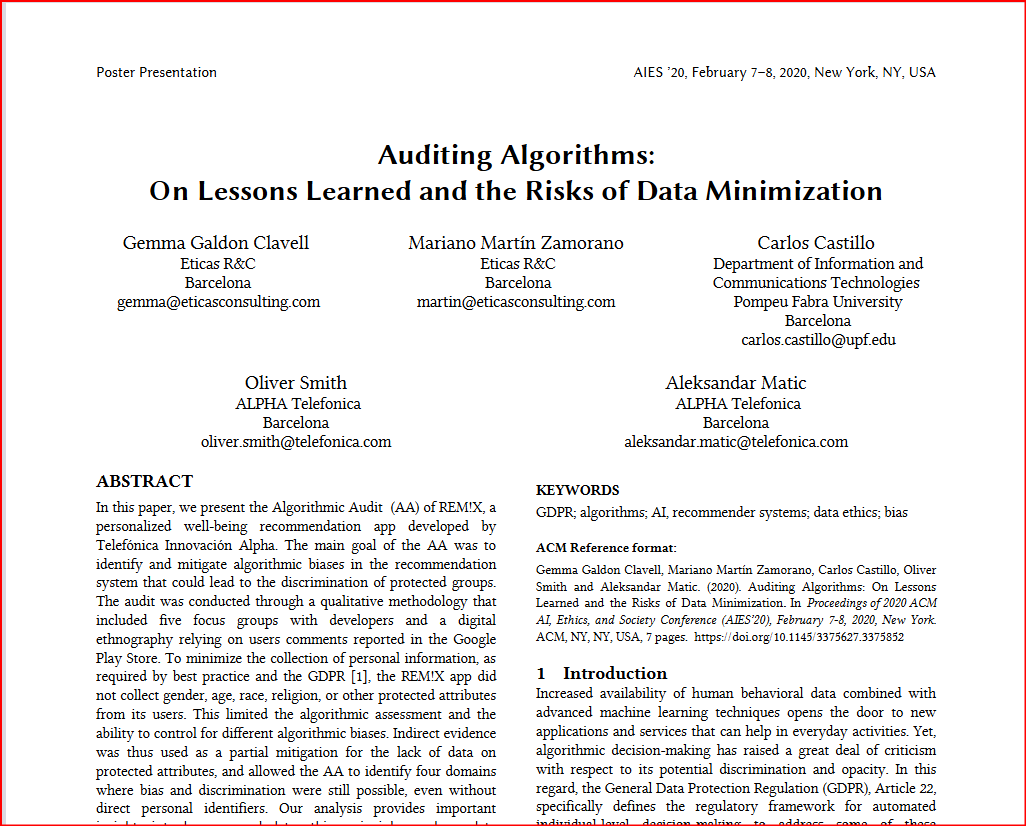
This paper presents the evaluation (algorithmic audit) of REM!X, a personalized well-being recommendation app developed by Telefónica Innovación Alpha. The main goal of the evaluation was to identify and mitigate algorithmic biases in the recommendation system that could lead to the discrimination of protected groups.
The audit was conducted through a qualitative methodology that included five focus groups with developers and a digital ethnography relying on users comments reported in the Google Play Store. To minimize the collection of personal information, as required by best practice and the GDPR, the REM!X app did not collect gender, age, race, religion, or other protected attributes from its users. This limited the algorithmic assessment and the ability to control for different algorithmic biases. Indirect evidence was thus used as a partial mitigation for the lack of data on protected attributes.
Smart Cities: Risks, Governance, and Surveillance Insights
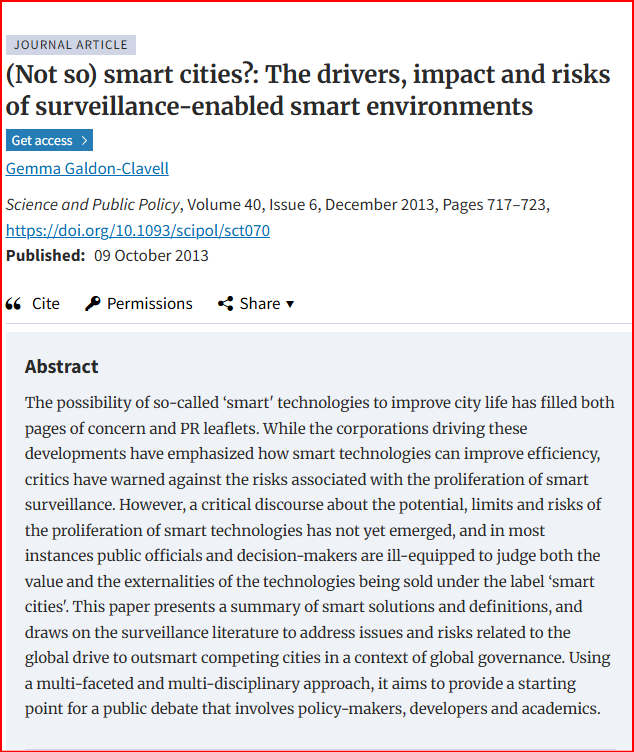
The possibility of so-called ‘smart' technologies to improve city life has filled both pages of concern and PR leaflets. While the corporations driving these developments have emphasized how smart technologies can improve efficiency, critics have warned against the risks associated with the proliferation of smart surveillance. However, a critical discourse about the potential, limits and risks of the proliferation of smart technologies has not yet emerged, and in most instances public officials and decision-makers are ill-equipped to judge both the value and the externalities of the technologies being sold under the label ‘smart cities'. This paper presents a summary of smart solutions and definitions, and draws on the surveillance literature to address issues and risks related to the global drive to outsmart competing cities in a context of global governance.
Participation and decision-making power in citizen science
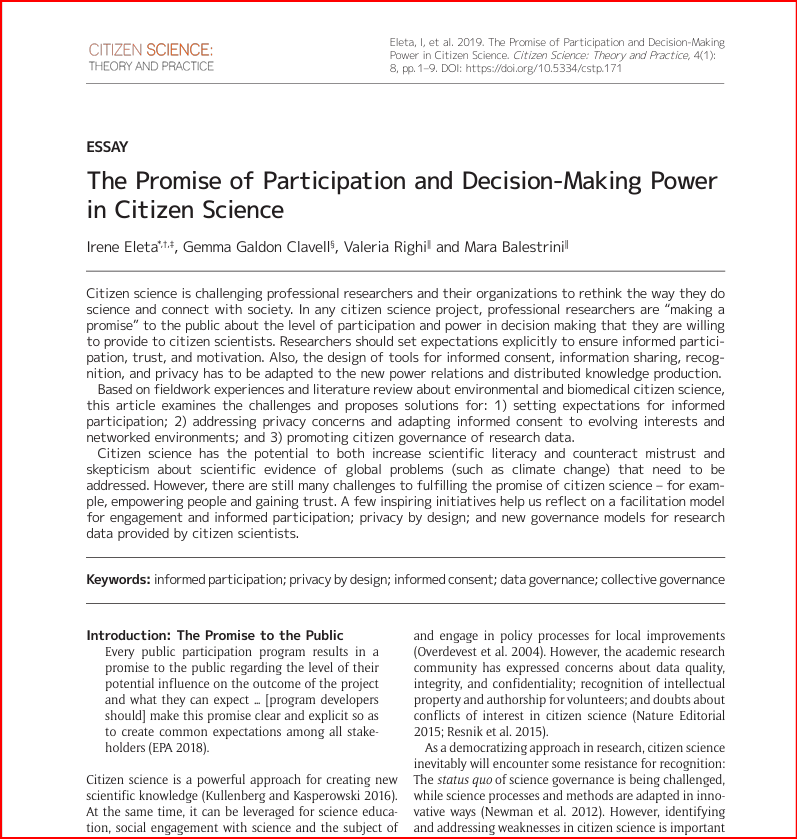
Citizen science is challenging professional researchers and their organizations to rethink the way they do science and connect with society. In any citizen science project, professional researchers are “making a promise” to the public about the level of participation and power in decision making that they are willing to provide to citizen scientists. Researchers should set expectations explicitly to ensure informed participation, trust, and motivation. Also, the design of tools for informed consent, information sharing, recognition, and privacy has to be adapted to the new power relations and distributed knowledge production.

Auditing an AI-based cybersecurity application
This assessment of a high-risk cybersecurity model revealed critical gaps in data quality, governance, and transparency. The work strengthened compliance with the EU AI Act and GDPR while significantly improving the system’s accuracy, fairness, and reliability.
Fairness in public-sector AI
The evaluation of Allegheny County’s homelessness risk tool examined performance and potential disparities across protected groups. The insights led to stronger monitoring, clearer procedures, and better guidance for teams using the system in practice.

Audit of an AI-based wellbeing support application
Safety, fairness, and privacy were tested across sensitive, real-world scenarios involving an AI wellbeing companion. The review sharpened crisis-response protocols, reduced subtle bias, and reinforced safeguards throughout the user experience.
Responsible AI for wellbeing apps
An ethics and algorithmic review of two digital wellbeing apps identified key opportunities to strengthen data transparency, accessibility, and inclusivity. The assessment supported the integration of responsible AI practices throughout product development.