
Eticas.ai has been evaluating AI systems in production since 2012. This is where we share what we’ve learned. You’ll find case studies from client work, practical guides on AI governance and evaluation, reports on emerging risks, interviews with practitioners, and a glossary of the concepts that matter most in the field. Whether you build AI, deploy it, or are accountable for its outcomes, this is the evidence base we work from.

Forbes Women Names Gemma One of the 35 Leading Spanish Women in Technology
Forbes Women included Gemma Galdon Clavell in "The top 35 Spanish Women in Technology" describing her as "a pioneer in algorithmic auditing software".

Eticas Co-Founds the International Association of Algorithmic Auditors (IAAA)
Our Founder and CEO, Gemma Galdon Clavell, PhD, co-founded the International Association of Algorithmic Auditors (IAAA) at the inaugural International Algorithmic Auditing Conference in Barcelona, alongside Cathy O'Neil (ORCAA, author of Weapons of Math Destruction), Dr. Shea Brown (BABL AI), Dr. Rumman Chowdhury (Humane Intelligence) and other leading voices in AI accountability. The IAAA's mission is to professionalize algorithmic auditing, promote auditing standards, and keep the discipline committed to the public interest rather than industry capture.

The Ethical Challenges of Artificial Intelligence
Full recording of the event "The Ethical Challenges of Artificial Intelligence" (University of Deusto, 26/10/2023): institutional address by Rector Juan José Etxeberria, keynote by Gemma Galdon Clavell (CEO, Eticas Consulting), and a Q&A session moderated by Professor Peru Sasia (Centre for Applied Ethics).

CEO Interview by Deusto University (v.o. Spanish)
Recording of the interview conducted by Lorena Fernández Álvarez, Director of Digital Communication at the University of Deusto, with Gemma Galdon Clavell, our CEO. Reflections on the social impact of algorithmic systems and the reproduction of society's biases in Artificial Intelligence processes. The impact of AI outputs tends toward the generation of small, homogeneous worlds rather than demanding larger, more heterogeneous ones. This interview was conducted on October 26, 2023, on the occasion of her participation as keynote speaker at the DeustoForum event, "The Ethical Challenges of Artificial Intelligence," at the University of Deusto (Bilbao Campus).

Ethical AI: Interview on Innoverse's FIBKCast
IEpisode of FIBKCast (Innoverse) with Gemma Galdón, founder and CEO of Eticas Research & Consulting, on developing a more ethical, safe, and human-centered AI, and its impact on everyday life through algorithms.

AI Risks Debate at DATAforum Justicia 2023 (v.o. Spanish)
Debate on AI risks alongside Daniel Gutiérrez, part of DATAfórum Justicia 2023, organized by the Spanish Ministry of Justice and the Principality of Asturias together with the University of Oviedo.

Our founder and CEO interviewed by Future Hacker v.o. in Spanish
Interview on the ethical challenges raised by the evolution of AI (ChatGPT and other platforms), with Dr. Gemma Galdon Clavell, founder and CEO of Eticas Consulting, recognized by Forbes in 2023. Covers her work in technology ethics, algorithmic accountability, and her role in designing the Algorithmic Audit Framework, the basis of the Algorithmic Bias Tracker.

Algorithmic Accountability
Algorithmic accountability refers to the obligation of organizations that develop or deploy AI systems to take responsibility for the outcomes those systems produce — and to be able to demonstrate that responsibility to regulators, affected individuals, and the public.

Fairness Testing
Algorithmic accountability refers to the obligation of organizations that develop or deploy AI systems to take responsibility for the outcomes those systems produce — and to be able to demonstrate that responsibility to regulators, affected individuals, and the public.

Model Drift
Fairness testing evaluates whether an AI system produces systematically different outcomes for different groups of people in ways that are unjustified, harmful, or legally impermissible.

AI Explainability
AI explainability is the degree to which an AI system's outputs can be understood by the people responsible for them and by those affected by them. In practice, this means being able to account for why a system produced a given output, which inputs influenced the result, and how confident the system was in its decision.

Post-Deployment Monitoring
Post-deployment monitoring is the continuous tracking of an AI system's behavior after it has been deployed into production. AI systems are not static: they encounter new data distributions, edge cases, and usage patterns that pre-deployment testing could not anticipate. Without systematic monitoring, organizations discover drift, emerging bias, or degrading accuracy only when the consequences are already visible.

AI Risk Assessment
AI risk assessment is the process of identifying, measuring, and prioritizing the risks associated with an AI system before and during its deployment in production.

EU AI Act
The EU AI Act is the European Union’s framework for regulating artificial intelligence systems, with obligations that vary based on the risk level of the AI system in question. High-risk AI systems — those used in employment, education, healthcare, law enforcement, and critical infrastructure — are subject to the most stringent requirements, including mandatory conformity assessments, transparency obligations, and ongoing monitoring.

Socio-Technical Auditing
Socio-technical auditing evaluates an AI system as a complete system, not just the AI models that are used. It assesses data flows, model behavior, business rules, user interface, human oversight, organizational processes, and the real-world outcomes the system produces.
AI Governance
AI governance refers to the frameworks, policies, processes, and oversight structures that determine how AI systems are developed, deployed, and monitored within an organization. It encompasses technical controls, human accountability, regulatory compliance, and the organizational structures that ensure AI systems behave as intended over time.

Algorithmic Bias
Algorithmic bias occurs when an AI system produces systematically different outcomes for different groups of people based on protected characteristics like race, gender, age, or socioeconomic status. It can originate in training data, in feature engineering that introduces proxy variables, or in threshold decisions that were never tested across the full population the system serves.
El País Interviews our CEO
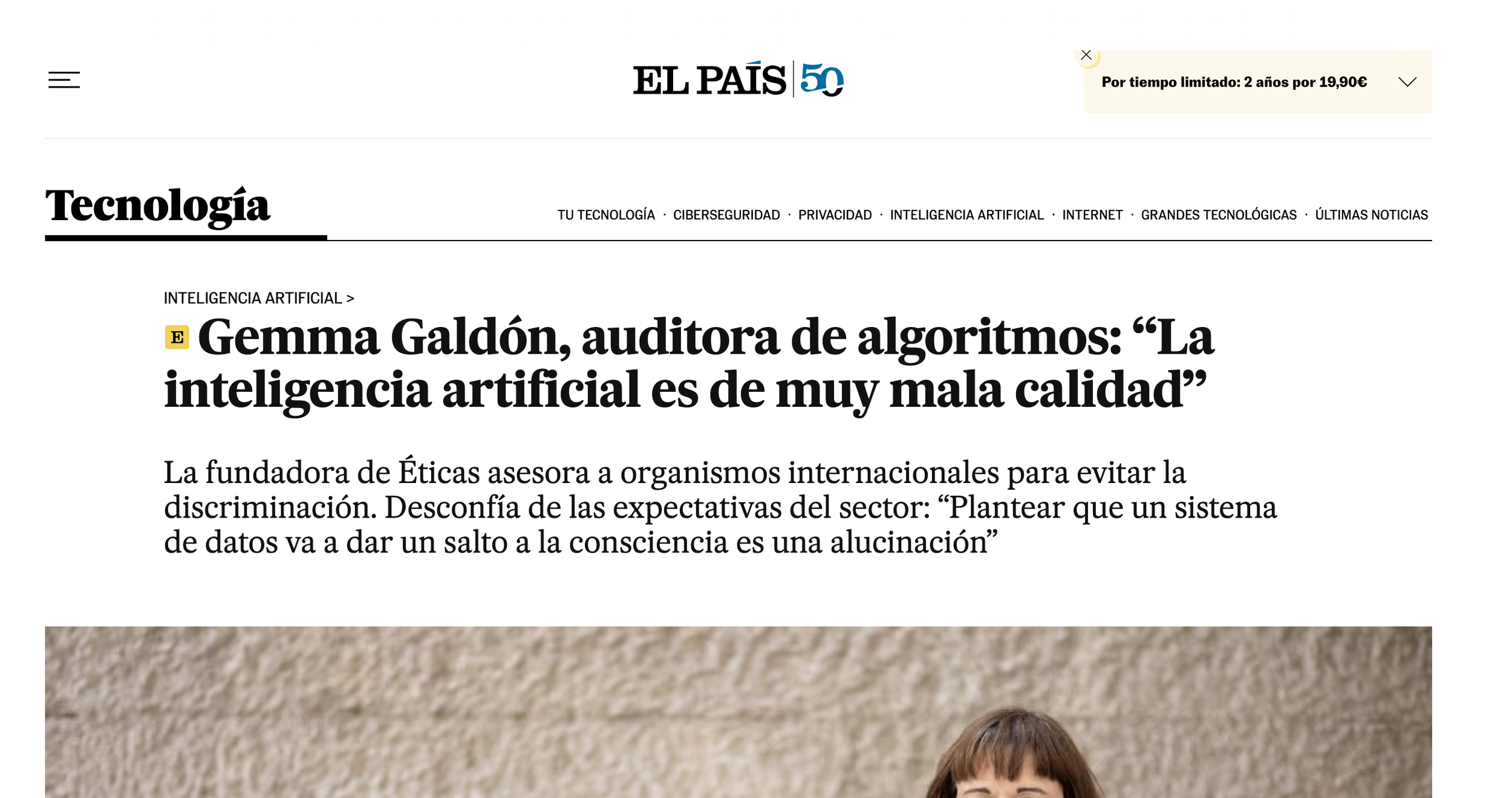
El País's technology section profiled our CEO in "Gemma Galdón, algorithmic auditor" discussing her work auditing AI systems and her critique of current tech industry regulation. The interview was widely republished by other Spanish-language outlets.

Gemma Galdon Clavell gives a keynote at MAICON 2022
Our Founder and CEO Gemma Galdon Clavell delivered a keynote at MAICON (Marketing AI Conference) titled "Ethical and Trustworthy AI: Lessons from the Front Lines," discussing AI ethics, algorithmic auditing and the practical implementation of responsible AI.
Evaluation of a well-being recommendation app by Telefónica
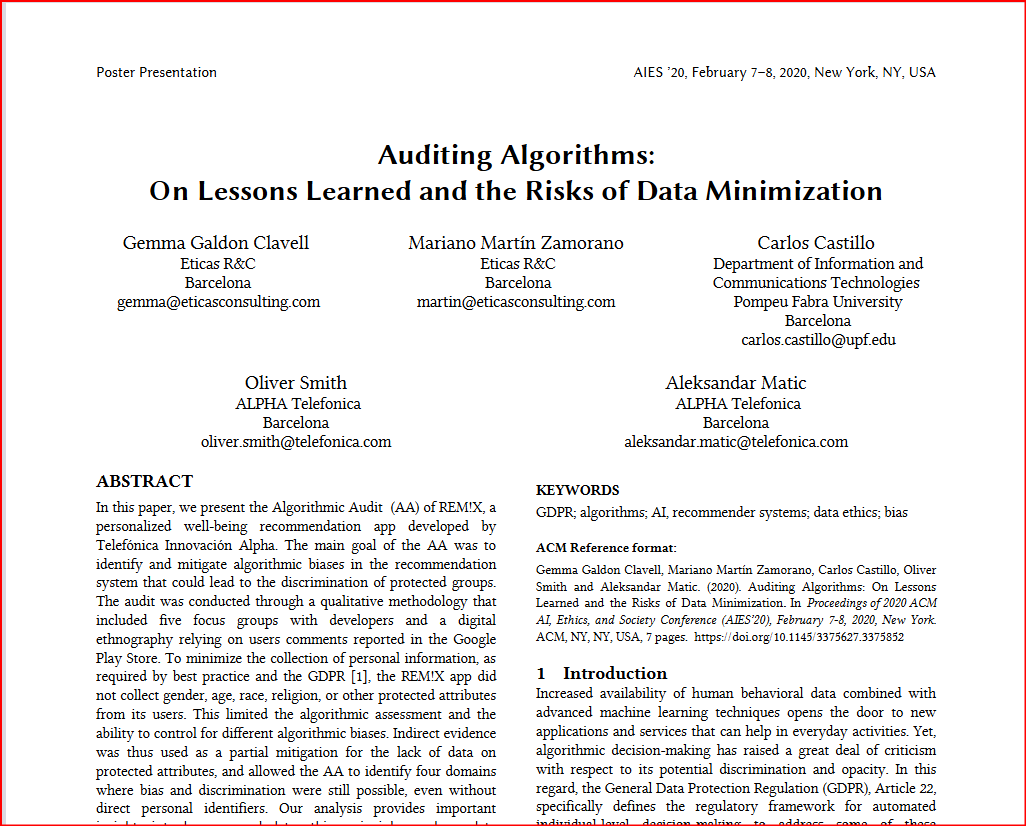
This paper presents the evaluation (algorithmic audit) of REM!X, a personalized well-being recommendation app developed by Telefónica Innovación Alpha. The main goal of the evaluation was to identify and mitigate algorithmic biases in the recommendation system that could lead to the discrimination of protected groups.
The audit was conducted through a qualitative methodology that included five focus groups with developers and a digital ethnography relying on users comments reported in the Google Play Store. To minimize the collection of personal information, as required by best practice and the GDPR, the REM!X app did not collect gender, age, race, religion, or other protected attributes from its users. This limited the algorithmic assessment and the ability to control for different algorithmic biases. Indirect evidence was thus used as a partial mitigation for the lack of data on protected attributes.